When closeness fades
Why is my partner pulling away?
Fewer messages, less closeness, and no clear reason.
A partner’s distance can come with stress, tiredness, something unsaid or changing feelings, and the distance alone cannot show which. This page cannot tell you why your partner is distant. If you feel safe, it can help you ask once, or ask what space means if you already asked, and watch what follows.
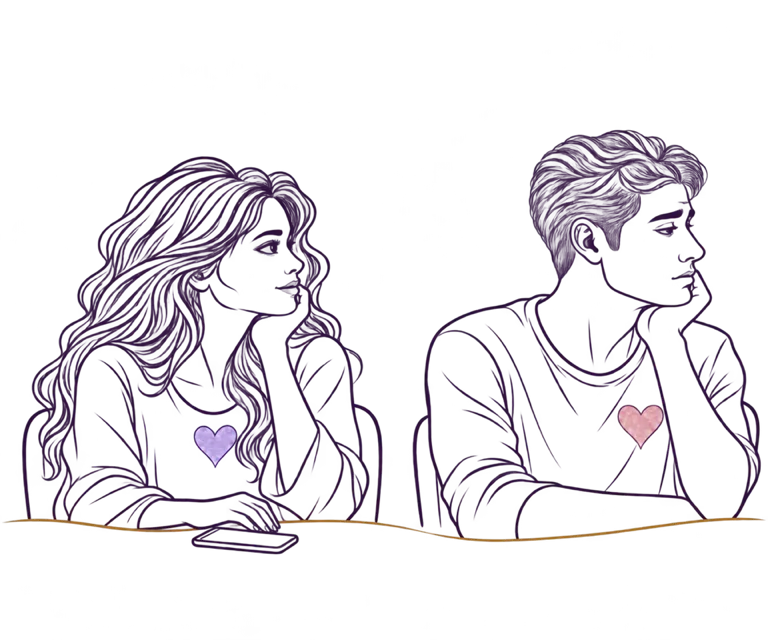
If the distance worries you right now, you do not have to settle it tonight. If you want to know where you stand, start by writing down what you have seen, separate from what you fear.
Start here
Does this sound familiar?
People describe these moments when a partner seems further away. In each of them, the contact has changed without a clear reason, and that is part of what makes it hard.
Why so few messages?
A partner who used to write during the day now answers late and briefly. There was no obvious event to point to.
Is it really just tiredness?
One partner asked if everything is okay and heard “just tired”. Weeks later, it still feels like more than that.
How much space is enough?
One partner said they need some space. The other gave it, and now does not know how much is enough, or what comes after.
What it looks like
What does it look like when a partner pulls away?
In this made-up example, the distance shows up as less contact, not as an argument. Priya and Daniel have been together for two years. Over the last six weeks, Daniel has written less during the day, cancelled two plans and seemed far away in the evenings. These are some of their messages from the last week.
Nothing in these messages says why Daniel is quieter. They show less time, shorter answers, and an answer Priya is not sure about. They do not show whether it is about work, about the two of them, or about something else.
Understand: what it means
What does it mean when your partner pulls away?
When a partner pulls away, it can mean several things, and the distance alone does not tell you which. Fewer messages, cancelled plans or less affection are real changes, and it makes sense that you notice them. They can come with stress, tiredness, worry, something unsaid between you, or changing feelings.
What you see and what you fear are two different things.
It can help to write down five short steps: what happened, what it means to you, what you feel, what you want to do, and what you may need. For the last one, you can ask yourself: what do I need most right now, to know where I stand, more closeness, or something else?
The meaning you give it is an explanation you have not tested yet, not a fact. You can look for two other explanations that fit the same facts, without having to believe them.
For Priya, the five steps could look like this:
- 1. What happened: six weeks of fewer messages, two cancelled plans, and “I’m just tired”.
- 2. What it means to Priya: “Daniel is losing interest in me.” Priya has not tested this explanation yet.
- 3. What Priya feels: worry, and feeling rejected.
- 4. What Priya wants to do: ask again, or pull back too.
- 5. What Priya may need: to know where Priya stands, and to feel close again. Only Priya can say which fits.
Two other explanations could also fit the same facts: “Daniel may be worn out by something I don’t know about.” “There may be something between us that Daniel has not said.” Only Daniel can say what is going on for Daniel.
Not knowing where you stand can change how you read messages. In research, this is called relational uncertainty.
In a study of 125 married couples by Leanne Knobloch and colleagues, spouses who were less sure about their relationship judged their partner’s messages in a conversation more negatively. Outside observers who rated the same messages did not judge them differently by how sure the couple was.[1]
Understand: am I overthinking?
Is my partner pulling away, or am I overthinking?
Noticing several changes over weeks is not the same as overthinking; one slow reply cannot tell you the whole story. Several changes together, like fewer messages, cancelled plans and less closeness, are worth naming and worth one question. What you cannot do from the outside is decide what they mean.
For Priya, one short message would not mean much. Six weeks of fewer messages, two cancelled plans and quieter evenings are a pattern Priya can describe to Daniel.
Feeling unsure and talking less about the relationship can go together, for you or for your partner. In a daily study of 202 college-aged dating partners by San Bolkan and colleagues, people talked less about their relationship on days when they felt less sure about it.[2]
Right now: ask once
What should I do when my partner pulls away?
If you feel safe with your partner and have not asked yet, one option is to name what you have noticed, calmly, and ask once.
If you already asked and heard an answer you doubt, you do not need to keep asking. You can still come back to it later when you need clarity, or ask what space means if your partner asked for it.
Three ways to do it:
- In person: choose a quiet moment at home or on a walk, and ask whether now is a good time. Then say what you have noticed, that you miss your partner, and ask an open question. If the answer is “not now”, you can ask when would suit instead.
- If you rarely see each other: a short message can ask for a time to talk, rather than raising the whole topic by text.
- If your partner says they need space: you can ask how much and what kind, such as less time together, fewer messages or a weekend alone, and when would be a good time to check in.
You can leave room for your partner’s answer and, if it is true for you, say that the relationship matters to you.
Priya asked once by message and heard “I’m just tired”. If Priya wants to ask once more, calmly and in person, that could be: “Is now an okay time? I’ve noticed we’ve had less time and fewer messages these last weeks. I miss you. How are you doing? Is something between us on your mind?”
By message, Priya could write: “Could we talk this weekend? I miss you, and I’d like to understand how you’re doing.” If Daniel asks for space, Priya can ask: “How much space do you need? When should we check in?”
People can expect a talk like this to go worse than it does. In experiments by James Dungan and Nicholas Epley with recalled, imagined, simulated and real conversations, people overestimated how negatively others would react to an open, direct conversation about a concern.[3] It did not study partners who pull away and cannot predict your partner’s reaction.
In a study of 180 couples by Nickola Overall and colleagues, one partner asked the other to change something.[4] People who find closeness uncomfortable, called attachment avoidance, showed less anger and withdrawal at moments when the asking partner respected their choice and showed they were valued. It studied talks about a requested change, not weeks of distance.
Right now: what to avoid
Should I give my partner space or keep asking?
You can give space and still ask: ask once, clearly, and then give space instead of asking again and again in small ways. Repeated questions, checking when your partner was last online, or testing whether your partner reacts may add pressure without bringing an answer.
This can turn into a cycle called demand-withdraw: the more one person presses, the more the other may pull back.
For Priya, coming back to the question is understandable. If Priya asked again each evening and checked when Daniel was last online, the talk could turn to the pressure instead of the six weeks.
In a meta-analysis of 74 studies by Paul Schrodt and colleagues, one partner pressing and the other withdrawing was linked with worse outcomes for the people and their relationships, more strongly in couples already in distress.[5] It shows a link, not a cause, and not which side starts it.
Right now: after the answer
What if my partner says nothing is wrong?
“Nothing is wrong” does not make the change you see unreal, and you do not have to argue about it. You also do not have to pretend you have not noticed.
You may hear reassurance, an explanation, or no clear answer, and each leaves you a next step:
- Reassurance: you can say that you have still felt some distance and would like to hear it if something comes up. Then leave it there for a while.
- An explanation: you can listen before trying to solve it, and ask what would help right now.
- No answer at all: you have asked, and for now the answer is no answer. You can say what you need, like one evening a week, and decide your own next steps without waiting for permission.
For Priya, after “I’m just tired”, that could be: “Okay. I’m glad if it’s nothing. I’ve still noticed we have less time together, so if something comes up, I’d like to hear it.” If Daniel says the work weeks have been draining, Priya could ask: “What would help right now?”
Going forward: what to watch
How long should I wait when my partner pulls away?
There is no fixed number of weeks to wait when a partner pulls away. What tells you more is whether the distance can be talked about and whether your partner follows through on small plans. No sign guarantees that the closeness comes back.
If your partner said they are stressed or need space, you can note it as information, not as something to believe or disprove.
Things you can watch over the next weeks:
- can you talk about the distance at all, even briefly,
- does your partner follow through on small plans, like a call or a date,
- do moments of closeness still happen,
- does it change when a named stress eases.
You can reassess at any point, not only after months. If each attempt to talk ends without an answer, or you keep setting aside what you need, that is enough reason to pause and look at what you need. Reassessing does not mean deciding today.
Talking it through with someone you trust, or with a counsellor for yourself, can help with that.
For Priya, the next weeks can show whether plans like Saturday happen again and whether Daniel returns to the question. If not, asking again is optional, not a duty.
The steps on this page are for distance, not for fear. Pulling away on its own does not show whether control is involved or whether you are safe.
This page cannot tell you whether what is happening is abuse. If you feel afraid, unsafe or controlled, or you are unsure, please contact a confidential support service directly rather than relying on this page to judge it. These services are independent of lovlov and are there for exactly this; lovlov is not built for it.
Understand: your partner’s side
Why do people pull away from a partner?
People can pull away for different reasons, and some have little to do with the other person: stress, exhaustion, worry, health, something hard to say, doubts about the relationship, or changing feelings.
A partner who is close one day and distant the next, or who pulls back after a good weekend together, can have any of these reasons; the pattern alone does not show which.
Two kinds of things can shape it:
- Things happening now: pressure at work, money, family, sleep or health can leave less energy for closeness. Less energy for closeness does not tell you whether your partner’s wishes have changed. Stress that comes home from somewhere else is sometimes called stress spillover.
- Things from before: earlier experiences may make closeness, or a difficult talk, feel harder for some people. This is a possibility, not something you can see from the outside.
For Daniel, one possible path could look like this:
- What happened: long weeks at work, as one possible context.
- What it might mean to Daniel: “I’m too tired in the evenings to talk much.”
- What Daniel might feel: tired, stressed, or unsure what to say.
- What Daniel might do: answer briefly and cancel plans.
A different path would start with something between Priya and Daniel that Daniel has not said. The two paths can also affect each other: if Priya asks more, the questions become part of what Daniel deals with, and Daniel’s shorter answers become part of what Priya reads next.
Pressure from outside has been studied this way: in a diary study of 86 spouses over 56 days by Meredith Sears and colleagues, people showed less affection and shared less with their partner on overloaded days, and this went with a wish to withdraw from others.[6]
If you want to know, you can ask your partner: “Is something wearing you out at the moment?” This is one possible path, not Daniel’s own account; only Daniel can tell it. You are not responsible for your partner’s feelings, and understanding a possible reason does not mean accepting the distance without limit.
Going forward: your partner’s part
What can my partner do if they need space?
A partner who needs space can say so in one sentence, with about how long and one small way to stay in touch. If you are that partner, this can give the other person more information about what the space means and when to check in.
Right now, for Daniel, that could be: “I need some quiet evenings for the next two weeks. Can we keep Saturdays for us, and talk properly after that?”
Going forward, coming back to it when you said you would is part of the answer. If something between you is the reason, saying so when you are ready is also an answer. Whether to do any of this is your choice.
Going forward: together
How can we stay close when one of us needs space?
One way, if you both want it, is to agree on how much space to take and how you stay in touch. Needing space for a while can be part of a relationship.
Right after a talk, it can be enough to agree on when to talk again. For the weeks after, an agreement can cover:
- the one who needs space says so, instead of just going quiet,
- about how long until you check in,
- whether any small contact feels right, such as a goodnight message,
- coming back to it as agreed.
For Priya and Daniel, it could be two quieter weeks, one evening together each weekend, and a talk afterwards about how it went.
Using this for weeks of distance is our own suggestion. The closest source is a clinical article by Karen Rosen and colleagues, from work with couples where there had been low-level violence, on a time-out from an argument that both partners learn together; the authors warn that a time-out taught to one partner alone can fail or be misused.[7]
Keep in mind
Is my partner losing interest?
From distance alone, you cannot tell whether your partner is losing interest. Your partner’s own answer can tell you more, and it may not come soon. You can also look at whether the relationship as it is meets your needs.
For Priya, Daniel’s own account is still missing. Priya’s decisions about Priya’s own time do not have to wait for it.
Beyond this page
Where does your relationship really stand right now?
See what you need and how well each need feels met. Your results list your needs from most to least important to you. Your result is yours as soon as you finish, even if your partner never takes the test.
Your partner can take the test too and gets a separate profile. Once you have both finished and both choose to share, you can compare your answers instead of relying only on your guesses. You see what is strongest between you, what needs attention and, if you guessed for each other, where your guesses and the answers differ.
The free lovlov Basic test looks at the relationship as a whole, not at one hard moment. You can do everything on this page without it. You can start alone, and your partner can join later, at any time.
The best part: neither of you sees the other’s answers before you have both finished.
What lovlov isn’t
- It doesn’t diagnose you or your partner, or replace therapy.
- It doesn’t provide crisis support or trauma treatment.
- It’s not a medical device.
If you don’t feel safe, or you’re not sure, here’s where to turn →
Still wondering
What else do people ask?
Did I do something wrong?
Distance alone cannot tell you. Something you did may have played a part, and that is different from being responsible for how your partner deals with it. If you think of something specific, you can name it and ask whether it matters to your partner.
How do I stop overthinking while I wait?
One option is to pick one set time a day to think about it, instead of looking for signs all day. When a fear starts to feel certain, you can check whether it is something you saw or something you fear. Time with friends, rest and your own plans can also make the waiting easier.
Next steps
Where can I go from here?
Next, you can look at the pattern behind it, plan space with a way back, or choose a different situation.
The evidence
What can the studies tell me, and what not?
Our honest read. That distance alone cannot show its reason, and that earlier experiences may make closeness harder for some people, is our reading; none of these studies followed partners who pulled away over weeks, and they show links, not causes. The steps on this page are advice without a direct study.
- Leanne Knobloch, Laura Miller, Bradley Bond and Sarah Mannone (2007), Relational uncertainty and message processing in marriage
Study: Study of 125 married couples in videotaped conversations, with ratings by the spouses and by outside observers.
Supports here: that uncertainty can go with reading a partner’s messages more negatively.
What it cannot show: It studied married couples in recorded conversations, and it cannot tell you whether you are overreading.
- San Bolkan, Alan Goodboy, Megan Dillow, Rebekah Chiasson and Megan Vendemia (2024), Dynamic and daily partner-specific processes of relationship uncertainty and enacted relationship talk
Study: Daily study of 202 college-aged dating partners over 30 days.
Supports here: that uncertain days can go with less talk about the relationship.
What it cannot show: It shows association, not that uncertainty causes less talk.
- James Dungan and Nicholas Epley (2024), Surprisingly good talk: misunderstanding others creates a barrier to constructive confrontation
Study: Experiments with recalled, imagined, simulated and real confrontations.
Supports here: that an open, direct conversation may go better than you expect.
What it cannot show: It did not study partners who were pulling away, and it cannot predict your partner’s reaction.
- Nickola Overall, Jeffry Simpson and Helena Struthers (2013), Buffering attachment-related avoidance: softening emotional and behavioral defenses during conflict discussions
Study: Video study of 180 heterosexual couples discussing a change one partner wanted; avoidance was measured as a trait.
Supports here: that respecting autonomy and showing the partner is valued can soften withdrawal.
What it cannot show: It studied discussions about a requested change, not weeks of distance.
- Paul Schrodt, Paul Witt and Jenna Shimkowski (2014), A meta-analytical review of the demand/withdraw pattern of interaction and its associations with individual, relational, and communicative outcomes
Study: Meta-analysis of 74 studies with 14,255 people; the pattern is linked with worse personal, relationship and communication outcomes, more strongly in distressed samples.
Supports here: that pressing and withdrawing can go together with worse outcomes.
What it cannot show: The studies show association, not that one more question causes withdrawal.
- Meredith Sears, Rena Repetti, Theodore Robles and Bridget Reynolds (2016), I just want to be left alone: daily overload and marital behavior
Study: Diary study over 56 days with 86 spouses.
Supports here: that overloaded days can go with less affection and sharing.
What it cannot show: It is a small sample, and it cannot tell you what is going on for your partner.
- Karen Rosen, Jennifer Matheson, Sandra Stith, Eric McCollum and Lisa Locke (2003), Negotiated time-out: a de-escalation tool for couples
Study: Clinical article on a time-out that both partners learn and agree on together, with feedback from couples in treatment.
Supports here: agreeing on a break together, rather than one partner taking it alone.
What it cannot show: It is about agreed breaks during conflict, not weeks of distance; it is not a controlled study, and it comes from work with couples where there had been low-level violence.