The pursue-withdraw loop
Why does my partner pull away the more I try to talk?
One of you asks for more, the other pulls back, and each move can lead to the next.
In a pursue-withdraw loop, also called demand-withdraw or pursuer-distancer, one partner asks for contact or change and the other pulls back, again and again. Each move can shape what the other person does next. This page cannot tell you why your partner pulls back; if you feel safe, it can help you change your own step.
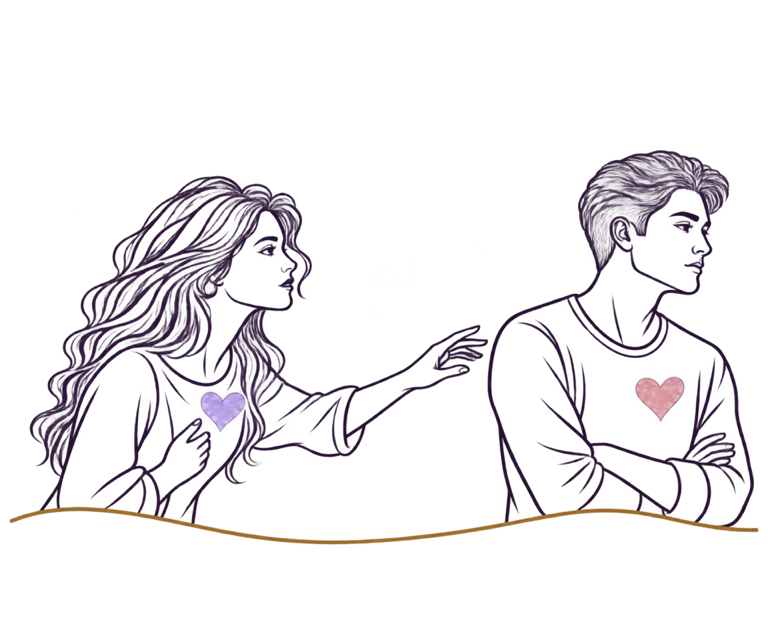
If you are in the middle of it right now, you do not have to fix the relationship tonight. If you feel safe, not asking a third time is one step you can take on your own, and your question still matters.
Start here
Does this loop sound familiar?
These are moments people describe when one person asks for contact and the other pulls back. This can happen without either person being to blame, and it can look different from each side.
If the relationship has already ended, the section on what to do after a breakup can help you decide what, if anything, to send.
Why does my partner need space right when I ask?
One person asks again, a little sharper. The answer gets shorter, and then the other person asks for space.
Did I push too hard?
After a breakup, one person looks back: the more they tried, the further away the other person went.
Why does every question feel like pressure?
For the one who pulls back, each new question may feel like more pressure, and there is no moment to think.
What it looks like
What does the pursue-withdraw loop look like?
In this made-up example, an ordinary question about the weekend turns into a chase. Lina and Robin live together. On Friday evening Lina brings up the weekend.
Robin goes for a walk. Lina sends two messages while Robin is out, and Robin answers neither. Saturday is still unplanned.
Check first
When does reaching out become control?
Reaching out becomes control when it is enforced through pressure, checking or fear, so that the other person cannot safely say no. That can happen in either direction. Asking twice, or needing space, does not on its own show control, and it does not tell you whether you are safe.
If your own reaching out has turned into checking where your partner is, going through your partner’s phone, or turning up where you were asked not to, it is crossing your partner’s boundary. It is worth getting support for yourself now.
If your partner does this to you, and your way out of a room is blocked, you are followed or watched, or you are afraid of what happens when you ask for space, the steps on this page are not the right place to start.
This page cannot tell you whether what is happening is abuse. If you feel afraid, unsafe or controlled, or you are unsure, please contact a confidential support service directly rather than relying on this page to judge it. These services are independent of lovlov and are there for exactly this; lovlov is not built for it.
If you are not in danger and the loop is about contact, time and closeness, the rest of this page is for you.
Understand: why it repeats
Why does it keep happening, even when I try?
It can keep happening because the question underneath stays open, so next time each of you tries harder, in opposite directions.
For Lina and Robin, the open question is whether there will be time together this weekend. Lina is the one who wants something to change; only Robin knows why Robin went for the walk.
Who presses can depend on who wants the change. In an observational study of 31 married couples, Andrew Christensen and Christopher Heavey found that both partners pressed more when discussing a change they wanted and pulled back more when discussing a change their partner wanted.[1]
A study of 50 married couples found the same switch by topic,[2] and so did a study of 75 couples that included same-sex couples.[3] So pressing does not have to be a personality, and pulling back does not prove that someone does not care.
In a survey of 219 people with a recurring argument, those who had first raised it often said they did so because they were very upset, and the pattern of one pressing and the other pulling back repeated in later episodes.[4] None of this shows who started it, and in your relationship it may have started differently.
Understand: the loop
How does the pursue-withdraw cycle work?
Each move can shape what happens next: asking can be followed by pulling back, and pulling back can be followed by more asking. You can follow it step by step: what one person does, how the other may read it, the response, and how that leads into the next round.
For Lina and Robin, one round could look like this:
- What happened: Lina asks about Saturday, then asks again. Robin says “Let’s see”, then “I don’t know yet”, and asks for space.
- What it may mean to Lina: “Saturday doesn’t matter to Robin.” This is Lina’s explanation, and Lina has not tested it yet.
- What Lina may feel: lonely, or unimportant.
- What Lina feels pulled to do: ask again, and send messages while Robin is out.
- What Lina may need: to know there will be time together. Only Lina can say whether that fits.
- How Robin may read it: the second question as pressure. Robin may step further back.
- What leads into the next round: Robin’s step back becomes part of what Lina reacts to next, and Lina’s asking becomes part of what Robin reacts to.
Two other explanations fit Robin’s “let’s see”: Robin may not know yet, or may want time to think before agreeing to a plan. Robin may also be avoiding the conversation. Only Robin can say what was going on for Robin.
In the study of 75 couples, the more one partner pressed, the more the other pulled back, and the more both did, the less satisfied couples were.[3]
Understand: your part
How can I see my own part in the loop?
You can see your own part by looking at what you do right after your partner’s last move. You can only change your own step, so this is the one worth noticing.
Signs you may be on the asking side:
- asking again before the first question had time for an answer,
- sending messages while your partner is away,
- reading a short answer as a sign that you do not matter.
Signs you may be on the pulling-back side:
- shorter answers as the talk gets harder to stay in,
- leaving without saying when you will be back,
- agreeing when you do not really agree, just to end the conversation.
It can also help to ask yourself what you need most in that moment: time together, to know that you matter, a little room, or something else.
In the example, Lina’s second question and the two messages are steps on the asking side. Robin’s walk without a time to come back is a step on the pulling-back side.
If you are the one who goes quiet, the page on going quiet in an argument is written from your side. If the same argument keeps coming back, the page on the argument that keeps coming back may fit better.
Right now: your step
How do I break the pursuer-withdrawer cycle?
If you feel safe, one option is to change your own step at the moments it happens: when you notice you are asking again, while your partner has space, and later. Asking once more, or one more message “just to clarify”, can add to the pressure you want to ease.
- When you notice you are asking again: you can stop there, and say once that you will leave it for now. This is a change of routine you can make alone.
- While your partner has space: say once that you heard it, then do your own thing, like making dinner, calling a friend or planning your own Saturday. Following, asking “how long?” again, or watching the phone or the door can add pressure. This is not a tactic to make your partner come back.
- Later, when things are calmer: choose a quiet moment, ask whether now is a good time, then ask once, clearly, and say what you will do if there is no plan. If now does not suit your partner, you can ask when would. Your plan is not a punishment or a test.
- If you cannot talk face to face: one short message can ask the same, once.
For Lina, that could be: “I’ve already asked twice. I’m going to leave it for now.” When Robin leaves for the walk: “Okay. I’ll give you space. I’m going to do my own thing for a while.”
Later, at home, Lina could ask: “Is now a good time to talk about Saturday?” Then: “I’d still like time together tomorrow. If we don’t make a plan tonight, I’ll make my own plans for the afternoon.”
In studies, who pulled back changed with whose issue was being discussed.[2] For Lina, that can mean reading Robin’s step back as part of this topic, not as proof that Robin does not care. This is our suggestion, not a step any study tested.
How you ask can matter. In a study of 180 mixed-sex couples by Nickola Overall and colleagues, one partner asked the other to change something.[5] Partners who tend to keep their distance showed less anger and pulling away at moments when the asking partner was gentler: respecting their choice and showing they were valued.
Warmth outside the argument may matter too. In married couples, the link between this loop and lower satisfaction may be weaker when one partner often shows affection in daily life.[6]
If you like, try one of these once, the next time it happens, and watch what happens next: whether the topic comes back, and whether the conversation feels different. If it does not, you do not have to keep trying on your own: you can get support for yourself now and decide what you need.
Going forward: your partner’s part
What can my partner do?
One option for your partner is to name the break and when it ends, so you have more information about whether and when the conversation may continue. For Robin, that could be: “I’m not leaving the topic. I need an hour, then let’s plan Saturday.” The guide to coming back after a break goes through that step by step.
Your partner may have reasons you cannot see, such as pressure from outside or past experiences that shape how repeated questions are heard; only your partner can explain that, and you are not responsible for managing it. You can ask your partner what your asking feels like from the other side.
Understanding your partner’s reasons does not mean putting up with the distance without limit. Whether to try any of this stays your partner’s choice.
Going forward: together
How can we break the loop together?
If both of you feel safe and both want it, you can talk about the loop itself when you are not arguing, and then go back to the question it left open. For Lina and Robin, that question is still Saturday.
Lina and Robin could agree on:
- a sentence for each side: “I’m chasing again” and “I need a break, I’m not leaving”,
- that the one who needs space says roughly when they are back,
- taking turns on whose topic comes first, since in studies the one with the topic pressed more.[1]
These points are our suggestion; no study we found tested them as a set. If you cannot agree, either of you can stop and get support on your own.
After a breakup
What if the relationship has already ended?
If the relationship has ended, you can stop pursuing; sending nothing at all is a complete option. Looking back, you may see your own part in the loop; that is not the same as the ending being only your fault, and no one can tell you whether more space would have changed it.
Stopping is not a strategy to get anyone back. It is a way to stop the asking and the waiting.
If the other person has asked for no contact, respect that. Practical things such as keys, money or children can be handled briefly and factually.
If contact is welcome and there is something you need to say, one short message can say it, for example: “I can see now that I kept asking, and I’m sorry for the pressure. I won’t keep contacting you.” Then leave it there, whether or not an answer comes.
You can talk it through with a counsellor, on your own, now.
Reassess: common misreadings
What do people get wrong about this loop?
This loop alone cannot show that one of you is needy and the other does not care, that it comes from attachment styles, or that pulling back only does harm. Lina’s asking and Robin’s walk do not show any of these.
- “The one who chases is needy, the one who pulls back doesn’t care.” In studies, roles switched with whose topic it was.[2]
- “It’s an anxious-avoidant thing.” No study we could check shows that this loop comes from those labels; what each of you does in the interaction tells you more about this loop than a label does.
- “Pulling back only does harm.” In two studies by Jaclyn Ross and colleagues, in couples with less money, education and other resources, husbands’ withdrawing in this pattern went with steadier satisfaction for wives, possibly because there was little room to make the requested change.[7]
Reassess: what research shows
What does research say about demand and withdraw?
In research, this loop is called the demand-withdraw pattern; on average it goes with poorer outcomes, though some findings point the other way. For Lina and Robin, it cannot say how their Saturday will go; it describes averages across many couples.
A review of 74 studies with 14,255 people found a moderate link between this pattern and poorer relationship and personal outcomes, similar whichever partner pressed.[8]
Over time the picture is mixed: in one study of 46 married couples, the pattern even went with rising satisfaction for wives,[9] and in a study of 176 couples, dissatisfaction also predicted the pattern four months later, except among young women.[10]
Couples therapy improved communication as well as satisfaction in a review of 58 studies of mixed-sex couples.[11] If you want that kind of help, you can look for it on your own or together.
Beyond this page
Where does your relationship really stand right now?
See what you need and how well each need feels met. Your results list your needs from most to least important to you. Your result is yours as soon as you finish, even if your partner never takes the test.
Your partner can take the test too and gets a separate profile. Once you have both finished and both choose to share, you can compare your answers instead of relying only on your guesses. You see what is strongest between you, what needs attention and, if you guessed for each other, where your guesses and the answers differ.
The free lovlov Basic test looks at the relationship as a whole, not at one hard moment. You can do everything on this page without it. You can start alone, and your partner can join later, at any time.
The best part: neither of you sees the other’s answers before you have both finished.
What lovlov isn’t
- It doesn’t diagnose you or your partner, or replace therapy.
- It doesn’t provide crisis support or trauma treatment.
- It’s not a medical device.
If you don’t feel safe, or you’re not sure, here’s where to turn →
Still wondering
What else do people ask?
What can happen when a pursuer stops pursuing?
No one can tell you in advance whether your partner will move closer. Stopping repeated requests is one step you can choose; whether it changes anything between you stays open, and your partner coming back is not the test of whether stopping was worth it.
What if my partner does not come back to the topic?
You can name it once as still open and give a time, for example: “I’d still like time together on Sunday. Could you let me know by Saturday evening?” If no answer comes, you can make your own Sunday plans and decide later what you want to do if the topic stays unanswered.
Next steps
Where can I go from here?
Next, you can read why the same argument keeps coming back, look at the loop from the quiet side, or plan the next break.
The evidence
What can the studies tell me, and what not?
Our honest read. The central explanation, that each move can become the other’s reason for the next, is our reading of studies that show pressing and pulling back going together in recorded discussions, mostly of married or mixed-sex couples; they show links, not causes, some point the other way, and none can tell why your partner pulls back.
Several steps are practical advice without a direct study: stopping after asking twice, giving space without following, asking once with your own plan, reading a step back as part of the topic, the message after a breakup, the partner’s sentence and the agreement for both.
The popular “anxious-avoidant” explanation and fixed minutes for a break have no study behind them that we could check, so this page does not use them.
- Andrew Christensen and Christopher Heavey (1990), Gender and social structure in the demand/withdraw pattern of marital conflict
Study: Observational study of 31 married couples in two discussions, one about a change each partner wanted.
Supports here: that both partners pressed more on a change they wanted and pulled back more on a change the other wanted.
What it cannot show: A small, older sample of married couples; it also found an average gender difference, which this page does not use.
- Nadya Klinetob and David Smith (1996), Demand-withdraw communication in marital interaction: tests of interspousal contingency and gender role hypotheses
Study: Observational study of 50 married couples, each discussing one issue raised by each partner.
Supports here: that who pressed and who withdrew followed whose issue was discussed.
What it cannot show: Married couples in recorded problem-solving discussions; it does not say what happens at home.
- Brian Baucom, Pamela McFarland and Andrew Christensen (2010), Gender, topic, and time in observed demand-withdraw interaction in cross- and same-sex couples
Study: Observational study of 75 couples: lesbian, gay, cohabiting and married mixed-sex couples.
Supports here: that partners pressed more on their own issue and pulled back more on the other’s, that one partner’s pressing went with the other’s withdrawing, and that more of both went with lower satisfaction.
What it cannot show: Recorded problem-solving discussions; it also found average gender differences, which this page does not use.
- Rachel Malis and Michael Roloff (2006), Demand/withdraw patterns in serial arguments: implications for well-being
Study: Survey of 219 people in romantic relationships about a serial argument.
Supports here: that the one who first raised it was often very upset, and that the pattern repeated in later episodes.
What it cannot show: Self-reports after the fact; it does not show who causes the loop.
- Nickola Overall, Jeffry Simpson and Helena Struthers (2013), Buffering attachment-related avoidance: softening emotional and behavioral defenses during conflict discussions
Study: Observational study of 180 mixed-sex couples in which one partner asked the other to change something; attachment avoidance was measured, and both rated their anger every 30 seconds while watching the recording.
Supports here: that for people who tend to keep their distance, a gentler approach went with less anger and pulling away in those moments.
What it cannot show: Video-recorded discussions; it does not test a given sentence.
- John Caughlin and Ted Huston (2002), A contextual analysis of the association between demand/withdraw and marital satisfaction
Study: Study of married couples combining reports of demand-withdraw, everyday negativity and affection.
Supports here: that the link between the pattern and lower satisfaction may be weaker when one partner often expresses affection in daily life.
What it cannot show: Married couples; association only.
- Jaclyn Ross, Benjamin Karney, Teresa Nguyen and Thomas Bradbury (2019), Communication that is maladaptive for middle-class couples is adaptive for socioeconomically disadvantaged couples
Study: Two longitudinal studies of 515 and 431 couples with observed discussions.
Supports here: that husbands’ withdrawing in this pattern went with steadier satisfaction for wives in couples with fewer resources.
What it cannot show: Mixed-sex couples; the authors interpret why, the study does not test it.
- Paul Schrodt, Paul Witt and Jenna Shimkowski (2014), A meta-analytical review of the demand/withdraw pattern of interaction and its associations with individual, relational, and communicative outcomes
Study: Review of 74 studies with 14,255 people.
Supports here: a moderate link between the pattern and poorer outcomes, similar whichever partner pressed.
What it cannot show: Associations across studies, not causes.
- John Caughlin (2002), The demand/withdraw pattern of communication as a predictor of marital satisfaction over time
Study: Longitudinal study of 46 married couples.
Supports here: that the pattern went with lower satisfaction at the time but predicted rising satisfaction for wives over time.
What it cannot show: A small sample; the author calls the picture more complex than assumed.
- Silvia Donato, Miriam Parise, Ariela Pagani, Anna Bertoni and Raffaella Iafrate (2014), Demand-withdraw, couple satisfaction and relationship duration
Study: Study of 176 couples measured twice, four months apart.
Supports here: that dissatisfaction predicted the pattern four months later, except among young women.
What it cannot show: A short interval and a conference paper; the link did not hold in one subgroup (young women).
- McKenzie Roddy, Lucia Walsh, Karen Rothman, Gabe Hatch and Brian Doss (2020), Meta-analysis of couple therapy: effects across outcomes, designs, timeframes, and other moderators
Study: Review of 58 studies with 2,092 couples.
Supports here: that couples therapy improved communication as well as satisfaction.
What it cannot show: Mixed-sex couples only, 40 unique samples; it does not single out this loop.