When raising it turns into an argument
How do I bring something up without my partner getting defensive?
You ask one thing, and the answer is about something you did.
A concern can sometimes be heard as a personal attack, and the answer can turn into a defence. You cannot control your partner’s answer, but one practical question, raised in private at a calm moment, can be easier to hear. This page cannot say why your partner reacts this way; if raising things makes you afraid, that comes first.
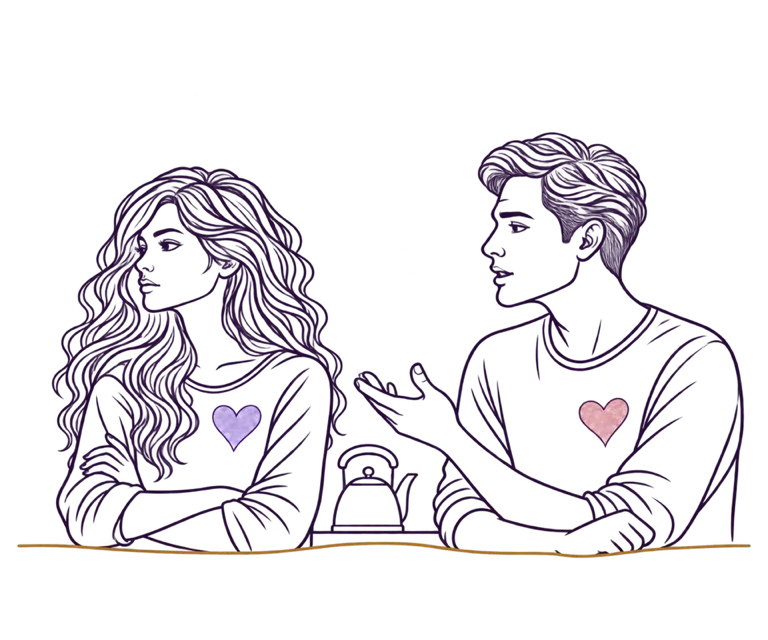
If it has just gone badly, you do not have to fix it tonight. If clear questions keep going unanswered, you do not have to keep searching for better words: you can decide your own next step.
Start here
Does this sound familiar?
People describe these moments when bringing something up turns into a different conversation. The first question gets lost. After a while, some people stop raising things at all.
The question turns around
One partner raises something practical. A moment later the talk is about something that partner did, and the first question has no answer.
Choosing words for days
One partner plans for days how to say it so it will not start an argument. It starts one anyway.
Keeping it to yourself
One partner has stopped bringing things up because it seems easier. The things themselves are still there.
What it looks like
What does it look like when my question turns into an argument?
It can look like a practical question that turns into a list of what the one asking has done wrong. Two weeks ago Lena promised to call the landlord about the broken heating. Noah brings it up in the kitchen.
The heating question is still open, and now there is a second topic. Noah drops both. It has gone like this with other things too, and lately Noah has stopped raising things at all.
The honest answer
Can the right words make my partner listen?
Not with certainty: some ways of raising a concern may make it easier for your partner to hear what you mean, but whether your partner listens is not up to you.
In the kitchen, Noah already asks about the next step (“I just need to know if you’ll call or if I should”), and it still goes unanswered. Clear wording is worth trying; it cannot make Lena engage.
In a study of 180 couples where one partner asked the other to change something, people who tend to pull away in close relationships got less angry and pulled back less at the moments when the request was kinder, for example when it showed that they were valued and could say no.[1]
Check first
What if I am afraid of how my partner will react?
If you hold back because you are afraid of how your partner will react, the steps on this page are not the right place to start.
The same holds if disagreeing has led to threats or punishment, or if your partner decides what you may do and enforces it with pressure.
Getting defensive, or answering a complaint with a complaint, does not on its own show whether control is involved or whether you are safe. In the kitchen, Noah drops the question after a complaint about the birthday, not after a threat.
In a survey of students in dating relationships, those who expected an aggressive reaction were more likely to keep complaints about a partner’s controlling behaviour to themselves.[2]
This page cannot tell you whether what is happening is abuse. If you feel afraid, unsafe or controlled, or you are unsure, please contact a confidential support service directly rather than relying on this page to judge it. These services are independent of lovlov and are there for exactly this; lovlov is not built for it.
If you are not in danger, and the difficulty is that concerns turn into arguments, the rest of this page is for you.
Understand: what happened
Was it what happened, or how I took it?
What happened is what was said and done; how you took it is the explanation you gave it. Separating the two shows what is still unanswered. You can also ask yourself: what do I need from an answer? The thing done, a fair share of the work, to feel heard, or something else?
Five short steps, as Noah might go through them:
- 1. What happened, only the facts: “I said the heating isn’t fixed and reminded Lena of the promise to call. Lena said it had been a bad week, said this is what I do, and mentioned the birthday. I said ‘Forget it.’”
- 2. How Noah took it: “I can’t raise anything,” or “Lena doesn’t care whether the heating works.” This is an explanation Noah has not tested yet.
- 3. What Noah may feel: frustrated, unheard, a little guilty about the birthday.
- 4. What Noah feels like doing: drop it, call the landlord without a word, or come back sharper next time.
- 5. What Noah may need: heating that works, and the sense that a request gets an answer. Only Noah can say which fits.
The facts show that the heating question got no answer. They also show that a second topic came in, the birthday.
They do not show whether Lena cares about the heating. Only Lena can say that.
Other explanations fit the same facts. Lena may have heard “you said you’d call” as criticism at a hard moment. Or Lena may have had a harder week than Noah knows.
Understand: why it happens
Why does my partner get defensive when I bring things up?
Your partner may get defensive when a concern sounds like criticism of the person, not a question about a problem. A defensive response may then come before an answer to the question.
For Noah and Lena: “You said you’d call” points at a promise. At the end of a hard week, Lena may hear “you’re unreliable” in Noah’s reminder, and then Lena brings up the birthday.
Things you can check:
- Person or behaviour: does the concern point at something done (“you said you’d call”) or at the person (“you’re so unreliable”)?
- Private or in front of others: was anyone else there?
- Timing: was it raised at the end of a hard day? Lena said it had been the worst week.
- What was agreed: was there a clear promise with a time, or only “I’ll call”?
- What came before: earlier hard talks can shape how either of you starts the next one.
- Unable or unwilling: your partner may not know how to answer, or may not want to. Only your partner can say which.
In a survey of 199 students about a complaint they had recently received from a friend or partner, complaints about the person felt more threatening than complaints about a behaviour. Complaints made in front of others felt more threatening too, and feeling threatened went with getting defensive.[3]
In an older study of couples’ conversations, couples who were doing well together more often complained about a behaviour, while couples who were doing less well more often complained about the person and more often answered a complaint with one of their own.[4]
Change it now
How do I bring up issues with my partner?
If you feel safe and want to try, one option is to raise one practical thing at a calm moment, in private, with one clear question. You can be clear without being harsh.
If your own frustration is high, go in with the question, not a verdict on your partner. If your partner turns it around in the middle, keep the two topics apart and come back to the second one later. The three moments below show what Noah could say about the heating.
1. Before you raise it: start with the practical problem.
- When and where: a calm time in private, not in the middle of another task. If now does not work, ask when would suit.
- If face to face keeps ending the same way: a short message can carry the same question.
- How to start: “The heating is still broken, and we need a next step. Will you call, or should I?”
- If it is a feeling, not a task: one option is the same shape, one moment, how it felt, one question: “When the birthday came up yesterday, I felt my question didn’t count. Can you hear that before we talk about the birthday?”
- Clear is not harsh: in two studies of newlywed couples, indirect negative remarks went with lower satisfaction, whatever the size of the problem.[5] In an online survey of 260 people, holding complaints back went with lower satisfaction, and affirming the partner while raising a complaint went with higher satisfaction.[6]
- If you mean it: “I know you’ve had a rough week. I also need us to decide about the heating.” Say it only if it is true, not as a technique to get a yes.
- What not to do: bring a list of earlier examples. A factual reminder is fine: “You were going to call. Is that still the plan?”
2. When your partner turns it around: keep the two topics apart.
- “I want to talk about the birthday too. Can we finish the heating question first, then come back to that?”
- If it gets harsher anyway, stop and say when you will come back to it. In a lab study, couples reacted less aggressively in a task after a break, both when the researchers set the break and when people chose to make it longer.[7] It did not test coming back to a talk at home. The guide to coming back after a break helps you prepare that.
- What not to do: wave the new topic away as unimportant.
3. Afterwards, if it stays unanswered: decide your own part.
- “I still need the heating sorted. If we haven’t decided by tomorrow evening, I’ll call the landlord myself.”
- Taking over once can solve the heating. If you find yourself taking over again and again, that is the pattern worth talking about, not a job to keep doing alone.
- What not to do: make the deadline a punishment. Some decisions are shared and cannot be settled alone. For those, the next step is a talk about what keeps happening, further down this page.
Change it: what to avoid
What can make it worse?
Some moves can add pressure or leave the first question without an answer, as happened with the heating. Apart from the checks above, for example:
- sarcasm or a loaded question instead of saying what you need,
- bringing several topics at once,
- answering a complaint with one of your own,
- dropping it with “Forget it,” so the question stays open without a time to come back.
Going forward: what to watch
How can I tell whether it is getting better?
Watch whether a clear question gets a clear answer, and whether you still raise things at all. Over the next few weeks, notice:
- whether clear, private questions get answers more than they used to, even “not now, tomorrow,”
- whether a complaint about you, like the birthday, gets its own talk later,
- whether you hold back less than you used to.
If you have gone quiet
What if I have stopped bringing things up?
If you have stopped bringing things up, one option is to talk about what keeps happening, not the next topic. Keeping things to yourself may avoid an argument in the moment, while leaving the issue unresolved.
Noah has started to hold back, so the next problem after the heating may not get raised at all.
In a survey of 393 people about complaints they had held back, holding a complaint back for longer went with the irritation coming up more often and mattering more, and that went with feeling less close and more distressed.[8] It does not show that raising every complaint would be better.
At a calm time, that could sound like this: “I notice that when I bring something up, we end up on a different topic, and the first question stays open. I’d like us to try one thing at a time.”
If your partner does not want to talk about it, you are free to decide what that means for you.
If speaking up feels too hard right now, talking it through with a professional on your own is open to you now. You do not have to wait for the next attempt.
Understand: your partner’s side
What might it look like for my partner?
A partner who gets defensive may hear the concern as criticism, even when the question is practical. What would make it easier to hear is something only your partner can tell you, and you can ask. One way it could go for Lena:
- What happened: “Noah brought up the heating at the end of a week like this.”
- What it might mean to Lena: “Nothing I do is good enough,” or “I’m being told off.”
- What Lena might feel: criticised, worn out, or uncomfortable about the missed call.
- What Lena might do: point to the week, then to something Noah forgot.
Those readings can shape what each person does next. If Noah thinks “I can’t raise anything,” Noah may make the next request sharper. If Lena thinks “I’m being told off,” Lena may answer more defensively.
Pressure from outside, such as a hard week at work, can change how much Lena can give right now; it does not say what Lena wants. Earlier experiences of criticism may also shape how a request is heard. Nothing in the scene says which applies.
This is one possible path, not Lena’s own account; only Lena can tell it. You are not responsible for your partner’s feelings, and understanding a possible reason does not mean accepting the behaviour without limit.
Understand: why it repeats
Why does it keep going this way?
It can keep going this way when each response shapes the next and the first question goes unanswered. For example, Noah and Lena might continue like this:
- Noah raises the heating two weeks after Lena’s promise.
- Lena may hear a verdict.
- Lena brings up the birthday.
- Noah drops it.
- Noah waits longer before raising the next concern and uses sharper words.
Which comes first, the sharp request or the defence, cannot be seen from the outside. A related pattern, one partner pushing and the other pulling back, has its own page.
For your partner
What can my partner do?
This part is for the partner who hears the concern, like Lena in the kitchen: one option is to answer the question first, then raise your own point.
Right now, for Lena, that could be: “Sorry, I haven’t called. I’ll do it tomorrow morning. And can we talk about the birthday later?”
Going forward, saying honestly that something is not possible right now, and offering what is, is also an answer. You could also say what would make a concern easier for you to hear. Whether to try any of it is your choice.
Going forward: together
How can we make it easier together?
If both of you feel safe and both want it, you can agree outside an argument how either of you raises something. Right after an argument, it can be enough to agree when to talk again. Going forward, Noah and Lena could agree on:
- a short way to ask for a time (“Can we talk about one thing tonight?”),
- one thing at a time, with a second topic noted for later, not dropped,
- a pause, with a time to talk again, if it gets harsh.
These points are our suggestion; no study we found tested them as a set. Either of you can say no to another try; then each of you decides on your own what to do next.
Check your part
Am I the problem?
This page cannot tell you whether you are the problem, but you can check your own part.
Ask yourself: was the concern about something done, raised in private, with one clear question? If it was, and the conversation still repeatedly shifts into accusations about you, that is not only a question of wording.
For Noah, the heating question was about a promise and raised in private. “You said you’d call” may still have sounded sharper than Noah meant. If Noah did forget the birthday, that is Noah’s part to answer, in its own talk.
A research review concluded that direct disagreement can help with a serious problem when the partner is able to change, and can do harm when a partner does not feel secure enough to respond.[9]
At some point it may help more to stop searching for new wording, look at the broader pattern, and ask yourself whether the relationship gives you what you need.
What you cannot know is what the request meant to your partner. Only your partner can tell you.
Beyond this page
Where does your relationship really stand right now?
See what you need and how well each need feels met. Your results list your needs from most to least important to you. Your result is yours as soon as you finish, even if your partner never takes the test.
Your partner can take the test too and gets a separate profile. Once you have both finished and both choose to share, you can compare your answers instead of relying only on your guesses. You see what is strongest between you, what needs attention and, if you guessed for each other, where your guesses and the answers differ.
The free lovlov Basic test looks at the relationship as a whole, not at one hard moment. You can do everything on this page without it. You can start alone, and your partner can join later, at any time.
The best part: neither of you sees the other’s answers before you have both finished.
What lovlov isn’t
- It doesn’t diagnose you or your partner, or replace therapy.
- It doesn’t provide crisis support or trauma treatment.
- It’s not a medical device.
If you don’t feel safe, or you’re not sure, here’s where to turn →
Still wondering
What else do people ask?
What if my partner gets angry when I bring something up?
If the anger makes you afraid, the section on fear comes first. If it does not, one option is to wait until the anger has passed and come back with one specific question. If every try meets anger, you can decide what you need without waiting for the right sentence.
Is defensiveness a red flag?
Not on its own. Getting defensive now and then can be a reaction to feeling criticised. It is more concerning when attempts to raise things repeatedly turn into accusations about you, or when you are afraid of how your partner will react.
Next steps
Where can I go from here?
Next, you can read why the same argument keeps coming back, what to do when you go quiet in an argument, or plan the next break.
The evidence
What can the studies tell me, and what not?
Our honest read: that a concern can sound like a personal attack and then gets defended instead of answered is our reading; the studies on complaints and on feeling threatened fit it but do not test it, and four of them are surveys that show links, not causes.
The review by Overall and McNulty also limits the advice: gentle, validating talk can do harm when a serious problem needs to change, so softening is not always the answer.
Advice without a direct study: leading with the practical problem, raising a feeling that way, going in with a question, asking for a time, keeping a second topic for later, your own plan if nothing changes, talking about what keeps happening, the joint agreement, and the reading that pressure or earlier criticism can shape how a request is heard.
- Nickola Overall, Jeffry Simpson and Helena Struthers (2013), Buffering attachment-related avoidance: softening emotional and behavioral defenses during conflict discussions
Study: Observational study of 180 mixed-sex couples in which one partner asked the other to change something; both rated their anger every 30 seconds while watching the recording.
Supports here: that for people who tend to keep their distance, a gentler approach went with less anger and pulling away in those moments.
What it cannot show: It looked most closely at people who tend to keep their distance in close relationships, in lab discussions; it does not test a given opening sentence.
- Denise Cloven and Michael Roloff (1993), The chilling effect of aggressive potential on the expression of complaints in intimate relationships
Study: Two-part survey of 160 college students in dating relationships.
Supports here: that expecting an aggressive reaction went with keeping complaints about a partner’s controlling behaviour to oneself.
What it cannot show: Students in dating relationships and a survey; it cannot tell whether a given relationship is abusive.
- William Cupach and Christine Carson (2002), Characteristics and consequences of interpersonal complaints associated with perceived face threat
Study: Survey of 199 college students about a recent complaint they had received from a friend or romantic partner.
Supports here: that complaints about the person and complaints made in front of others felt more threatening, and that feeling threatened went with defensiveness.
What it cannot show: Students’ recollections, friends included; it shows association, not that a given wording prevents defensiveness.
- J. K. Alberts (1988), An analysis of couples’ conversational complaints
Study: Analysis of complaints in couples’ conversations, comparing better- and less-adjusted couples.
Supports here: that better-adjusted couples complained more about behaviour, and less-adjusted couples more about the person and with more counter-complaints; the abstract reports no other links.
What it cannot show: An older study; it shows association, and the abstract does not give the sample size.
- James McNulty and Michelle Russell (2010), When “negative” behaviors are positive: a contextual analysis of the long-term effects of problem-solving behaviors on changes in relationship satisfaction
Study: Two longitudinal studies of newlywed couples.
Supports here: that indirect negative communication went with stably lower satisfaction regardless of how serious the problem was.
What it cannot show: Newlyweds in problem-solving discussions; it does not test the sentences on this page.
- Timothy Worley and Jennifer Samp (2018), Rejection sensitivity, complaint-related communication, and relational satisfaction: a mediation analysis
Study: Online survey of 260 people in relationships.
Supports here: that voicing complaints openly while affirming the partner went with greater satisfaction.
What it cannot show: One survey at one point in time; association only. It measured sensitivity to rejection in a general online sample.
- Annah McCurry, Robert May and David Donaldson (2024), Both partners’ negative emotion drives aggression during couples’ conflict
Study: Laboratory experiment with couples in an aggression task.
Supports here: that enforced breaks, and breaks people chose to make longer, reduced aggressive responses in a laboratory task.
What it cannot show: It did not test conversations at home, agreements between partners or picking a topic up later.
- Esther Liu and Michael Roloff (2015), Regret for complaint withholding
Study: Survey of 393 people about complaints they had held back in a relationship.
Supports here: that holding a complaint back for longer went with the irritation recurring and mattering more, and with less closeness and more distress.
What it cannot show: A survey; it does not show that raising every complaint would have been better.
- Nickola Overall and James McNulty (2017), What type of communication during conflict is beneficial for intimate relationships?
Study: Review of recent research on communication during conflict.
Supports here: that direct disagreement can help with serious problems when change is possible, and that its effect depends on how ready both people are to respond.
What it cannot show: A review; it cannot judge whether an individual request is fair.