When it gets too much
What is emotional flooding?
A word for being overwhelmed in an argument, and what it can and cannot explain.
Emotional flooding is feeling so overwhelmed during an argument with your partner that it becomes hard to think straight. It can help explain why the words went wrong; it does not excuse them. This page cannot tell you who was right; if you feel safe, it can help you calm down and repair what was said.
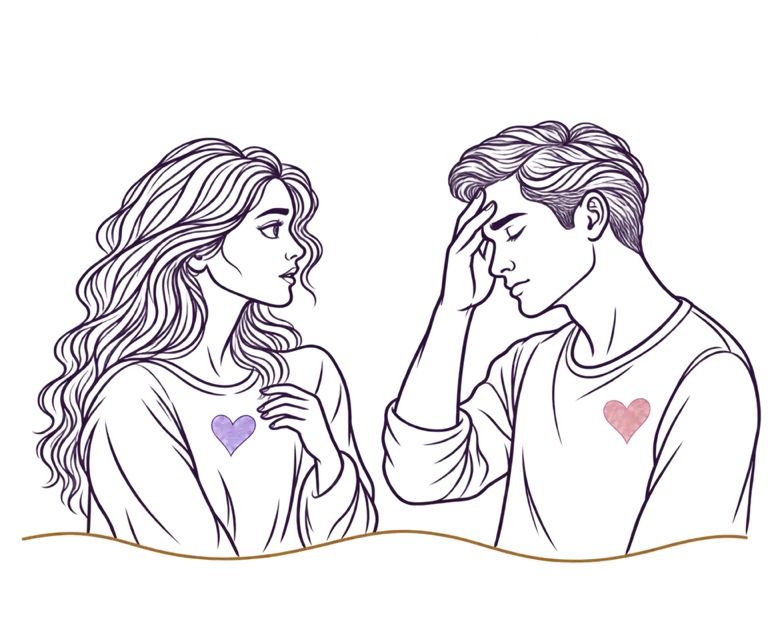
If it has just happened and you feel safe, you do not have to sort anything out tonight. If you can, wait with big decisions about the relationship until you are calmer; the question you were arguing about will still be there.
Understand: the word
What does emotional flooding mean in a relationship?
In a relationship, flooding means feeling so overwhelmed during an argument, for example by your partner’s strong emotion, that you can no longer take things in.
Flooding can be quiet or loud. Some people go blank and leave the room. Others speak faster and louder, cry, or say things they do not mean.
In the example on this page, Maya and Ellis argue about Ellis’s sister staying longer; the next section shows it.
John Gottman, a couples researcher, described flooding in a theory of how marriages come apart.[1]
Heather Foran and colleagues later built a questionnaire for flooding and tested it with 453 couples. They describe it as feeling overwhelmed by a partner’s negative emotion that seems sudden and intense, with the sense that you cannot take things in. They name escalating or withdrawing as possible reactions.[2]
What it is not:
- being angry about something, on its own,
- being afraid of your partner,
- a planned silence meant to make a point,
- a diagnosis or a personality type.
Understand: what it looks like
What does emotional flooding look like?
Flooding can look like an argument that speeds up until one person says something big and leaves. Here is one way it could look; a scene like this does not prove that someone was flooded. Maya and Ellis are clearing up after dinner when Maya brings up Ellis’s sister.
Ellis walks out and slams the door. An hour later Ellis is calm and regrets the sentence about living together.
From the inside, flooding can feel like getting hot, a racing heart, finding it hard to focus on anything else, or words coming too fast or not at all. From the outside, Maya saw a raised voice and a slammed door.
Check first
Is it flooding, or is it fear?
Flooding and fear can look similar from the outside, but they are different questions. Flooding is about feeling overwhelmed in the argument; fear is about what you think may happen if you speak, disagree or leave. The two can also happen together.
If you are afraid of your partner, or you hold back because of what your partner might do, start there. The steps on this page are not the right place to begin.
On its own, a raised voice or a slammed door does not show flooding or fear. It also does not prove that anyone is controlling, or that anyone is safe. For Maya and Ellis, the slammed door does not show whether Ellis was flooded or whether Maya felt afraid; only each of them can say.
In a study of 233 couples, flooding was reported more in distressed couples and in couples with partner violence; the study shows a link, not a cause.[3] That is one reason not to use the word to excuse harm.
This page cannot tell you whether what is happening is abuse. If you feel afraid, unsafe or controlled, or you are unsure, please contact a confidential support service directly rather than relying on this page to judge it. These services are independent of lovlov and are there for exactly this; lovlov is not built for it.
If your partner tells you that something you said or did frightened them, or you are concerned about your own behaviour in those moments, it is worth taking seriously. You can talk it through with a professional, on your own, now.
If you are not in danger, and the question is what happens to you or your partner in a heated moment, the rest of this page is for you.
Understand: what it cannot tell you
Does flooding mean I was wrong?
Flooding does not tell you whether you were wrong; it can help explain why thinking got harder, and it does not excuse what was said.
The word describes a state, not who was right. Sorting what happened from what it meant to you can show what needs repairing. You can use five steps: what happened, what it meant to you, what you feel now, what you feel pulled to do, and what you may need.
For the last one, a question to yourself with no right answer can help: “What did I need in that moment?”
For Ellis, the five steps could look like this:
- 1. What happened: only the facts. “Maya said I should have asked first. I said I can’t even help my sister. I said maybe we shouldn’t live together, and left.”
- 2. What it meant to Ellis: “I’m being told I’m a bad partner.”
- 3. What Ellis may feel now: unsettled, worried about the sentence, or ashamed.
- 4. What Ellis feels pulled to do: explain it away, or avoid the topic.
- 5. What Ellis may need: a question only Ellis can answer, such as “Do I need to feel trusted with my family, or do I need time to calm down before we talk?”
The facts show that Maya wanted to be asked first, and that Ellis said something about living together. They do not show that Maya called Ellis a bad partner. Ellis’s reading is a guess that has not been checked.
Other readings also fit Maya’s words: “Maya wants a say in who stays in the home Maya and Ellis share,” or “Maya was surprised by the change of plan.” Only Maya can say which is closer. Ellis can ask: “When you said you wanted to be asked, what did you mean?”
Find your situation
Which situations does the word fit?
The word can help in these situations, each with its own page:
- if the words go and you fall silent: going quiet yourself when you argue,
- if the same topic keeps setting it off: the same argument coming back,
- if raising a concern tips into an argument: a concern that turns into an argument,
- if shutting down has become a pattern: stonewalling.
Starting from your situation can help more than starting from the word.
Understand: why it happens
What causes emotional flooding?
Research links reported flooding with anger during the argument, in both partners; it does not show what causes it.
It may help to notice whether it starts when your partner gets angry, when you get angry, or both.
For Maya and Ellis, the scene shows Ellis getting louder. It does not show whether Maya was angry.
In a study of 233 couples during a ten-minute problem-solving discussion, people who reported more flooding had partners who felt and showed more anger, and were angrier themselves. Couples with at least one highly flooded partner solved the problem less well.[3] The study cannot say which comes first.
Tiredness, stress or past experiences may also play a part. That is our suggestion, not a finding, and nothing in the scene says which applies to Ellis.
Right now: before you decide
Should I decide anything while flooded?
If you feel safe, it may help to wait with big decisions until the flooding has passed.
If you already said it, for example that you want to break up, you can tell your partner what happened, without pressure: “I said I was done when I was overwhelmed. I don’t think I meant it, and I’m sorry.” Whether to talk again stays your partner’s choice.
This is about decisions made while overwhelmed. A decision you have thought through calmly is a different situation, and regret alone does not prove that a breakup was wrong.
For Ellis, “maybe we shouldn’t live together at all” was a sentence like that.
Ending the relationship, moving out or saying “we’re done” in a flooded moment can feel completely right at the time. Research on “hot” and “cold” states suggests that people in a heated state tend to overestimate how stable their current wishes are.[4] That research is not about couples; it is a reason for caution, not a rule.
Right now: calming down
How do I get out of emotional flooding?
If you feel safe, one option is to pause before saying more, do something that may help you settle, and repair afterwards. The studies on this page do not show how long a break at home should last, so choose a time you can keep and say it.
To make it happen less often, it can help to notice your own early signs, such as your voice getting louder or losing track of what your partner says. The calm-down pause is a step you can try on your own.
1. When it starts: say one sentence before you say something you regret.
- Say that you are too worked up to think clearly, that you need a break, and when you will be back.
- If you start thinking “we should break up”: “I’m too heated to make decisions about us right now.”
- What not to do: say “I’m done” when you only need a pause, or storm out without saying when you are back. If leaving the room would cause a new problem, you can stay nearby and stop arguing.
2. During the pause: try something that may help you settle.
- What may help: slow breathing, a slow walk, sitting somewhere quiet.
- What may not: writing messages, replaying every line, planning what to say when the argument starts again.
3. Afterwards: take back the exact words, then come back to the topic.
- Name what you said and take it back, without “but you made me say it”. If you still mean something, say that honestly instead.
- Setting: a calm moment when you both have time. Ask: “Can we talk about what I said last night?” If your partner says not now, ask when would be a better time, and leave it there.
- Then the original question, separately.
- If face to face is hard, a short message can start it: “I said things I don’t mean. I’m calmer now. Can we talk tonight?”
For Ellis, that could look like this. At the start: “I’m getting too worked up to think clearly. I need a break before I say something I regret. Can we pick this up at eight?”
Back at eight, Ellis could say: “I said maybe we shouldn’t live together. I don’t mean that, and I’m sorry I said it.” Then, separately: “Can we talk about my sister’s visit again?”
In a review of 154 studies, calming activities such as slow breathing reduced anger, while activating ones such as running or hitting a bag showed no benefit overall.[5] It was about anger, not couples.
In a lab study, couples who had to wait before reacting, or chose to wait longer, reacted less aggressively in a lab task.[6] It did not test a break at home or coming back to a conversation.
Right now: your partner’s part
What can my partner do when I flood?
One option for your partner is to allow some space, without following you and without dropping the subject.
Your partner does not have to accept hurtful words because they were said while flooded, and can say so later, calmly. Giving space also does not mean your partner’s own needs stop counting. Whether to try any of this stays your partner’s choice.
If you are the one who flooded, you can ask your partner later: “What was going on for you when I got loud?” Leave room for an answer you did not expect. Your partner may also carry stress or past experiences that have nothing to do with this argument. You are not responsible for working those out.
If you are the partner of someone who floods: you are not responsible for managing your partner’s flooding. A raised voice may also affect you strongly for reasons that are not visible in the moment; that is worth taking seriously too.
For Maya, giving space could sound like: “Okay, take a break. I’m here when you’re back. I still want to talk about the visit.” While Ellis is out, Maya could call a friend or go for a walk.
Going forward: together
How can we handle it together?
If both of you feel safe and both want it, you can agree outside an argument on what happens when one of you floods. For example:
- a short signal or sentence that means “I need a break, I’m not leaving the topic”,
- a time to come back, named by the one who needs the break,
- coming back first to any hurtful words, then to the open point.
The return can be the harder part: an agreement to pause helps little if the conversation does not come back.
If coming back keeps failing, neither of you has to keep renegotiating the same agreement. Each of you can decide what to do on your own, including getting support. The guide to coming back after a break helps you prepare a proposal.
For Maya and Ellis, the signal could be “I need a break, I’m not leaving the topic”, with eight o’clock as the time to come back.
Karen Rosen and colleagues describe a time-out that both partners work out and learn together, from their clinical work with couples where there had been low-level violence. It is a description, not a controlled test, and the authors note that a time-out only one partner learns can be misused.[7]
Understand: related words
How is flooding different from stonewalling?
Flooding is overwhelm during an argument; stonewalling is shutting down and no longer responding.
Flooding can be one reason someone shuts down, but the two are not the same.
Flooding can also be confused with a panic attack. This page cannot tell the two apart for you; a doctor or therapist can help you look at it.
Beyond this page
Where does your relationship really stand right now?
See what you need and how well each need feels met. Your results list your needs from most to least important to you. Your result is yours as soon as you finish, even if your partner never takes the test.
Your partner can take the test too and gets a separate profile. Once you have both finished and both choose to share, you can compare your answers instead of relying only on your guesses. You see what is strongest between you, what needs attention and, if you guessed for each other, where your guesses and the answers differ.
The free lovlov Basic test looks at the relationship as a whole, not at one hard moment. You can do everything on this page without it. You can start alone, and your partner can join later, at any time.
The best part: neither of you sees the other’s answers before you have both finished.
What lovlov isn’t
- It doesn’t diagnose you or your partner, or replace therapy.
- It doesn’t provide crisis support or trauma treatment.
- It’s not a medical device.
If you don’t feel safe, or you’re not sure, here’s where to turn →
Still wondering
What else do people ask?
Is emotional flooding linked to ADHD or autism?
The studies on this page do not show whether flooding is linked to ADHD or autism, so this page cannot say. It also makes no diagnosis; if flooding comes up for you a lot, also outside arguments, a doctor or therapist can look at it with you.
Can emotional flooding be a symptom of trauma or PTSD?
Flooding on its own does not show that trauma is behind it, and this page cannot tell you whether it is. If you wonder whether past experiences play a part, a therapist can help you look at it.
Does flooding mean we are incompatible?
Flooding alone does not tell you whether a relationship can work. You can watch whether breaks become clearer, whether the talk comes back, and whether hurtful words are acknowledged and repaired. In one trial, partners sounded less worked up in conflict after couples therapy, measured by voice pitch;[8] that still does not mean anyone has to stay.
Next steps
Where can I go from here?
Next, you can look at going quiet in an argument, read about stonewalling, or plan the next break.
The evidence
What can the studies tell me, and what not?
Our honest read: the definition rests on the flooding questionnaire and Gottman’s theory, and the link with anger and partner violence on one study that shows a link, not a cause, and no study tested this page.
The studies on decisions, anger and breaks are not about couples arguing at home, and the advice without a direct study is: the signs, the sentences to say, waiting with big decisions, the five steps, the repair, noticing early signs and the agreement for both.
Online figures such as a heart rate above 100 or a break of at least 20 minutes have no study we could inspect, so this page does not use them.
- John Gottman (1993), A theory of marital dissolution and stability
Study: Theory article on how marriages come apart, drawing on the author’s long-term studies of couples.
Supports here: that flooding is part of Gottman’s account of couples in conflict.
What it cannot show: A theory article; it discusses flooding but does not measure it the way the questionnaire below does. This page uses no heart-rate thresholds.
- Heather Foran, Michael Lorber, Jill Malik and colleagues (2020), The Intimate Partner Flooding Scale
Study: Development of a 15-item questionnaire with 453 couples.
Supports here: what flooding means: overwhelm by a partner’s intense negative emotion, with impaired thinking, and escalating or withdrawing as possible reactions.
What it cannot show: It measures how flooded people say they feel; escalation and withdrawal are proposed reactions, not findings about one person.
- Jill Malik, Richard Heyman and Amy Smith Slep (2020), Emotional flooding in response to negative affect in couple conflicts: individual differences and correlates
Study: Study of 233 married or cohabiting couples, some distressed and some with partner violence, in a ten-minute problem-solving discussion.
Supports here: that flooding went with the partner’s anger and one’s own, was reported more in distressed couples and couples with partner violence, and went with less effective problem solving.
What it cannot show: The sample deliberately included couples with partner violence; it shows association, not cause.
- George Loewenstein (2005), Hot-cold empathy gaps and medical decision making
Study: Review of research on decisions across emotional states.
Supports here: that people in a heated state tend to overestimate how stable their current preferences are.
What it cannot show: It is about decisions in general and in medicine, not about couples or breakups.
- Sophie Kjærvik and Brad Bushman (2024), A meta-analytic review of anger management activities that increase or decrease arousal
Study: Review of 154 studies with 10,189 participants.
Supports here: that calming activities reduced anger and activating ones showed no benefit overall.
What it cannot show: It is about anger, not flooding, and not about couples in particular.
- Annah McCurry, Robert May and David Donaldson (2024), Both partners’ negative emotion drives aggression during couples’ conflict
Study: Laboratory experiment with couples in an aggression task, with a replication.
Supports here: that enforced breaks, and breaks people chose to make longer, reduced aggressive responses in a laboratory task.
What it cannot show: It used a laboratory task, not a break at home or an agreement between partners.
- Karen Rosen, Jennifer Matheson, Sandra Stith and Eric McCollum (2003), Negotiated time-out: a de-escalation tool for couples
Study: Clinical description of a negotiated time-out, with feedback from couples in treatment.
Supports here: a time-out that both partners work out and learn together.
What it cannot show: It is not a controlled study, it comes from work with couples where there had been low-level violence, and it notes that a time-out taught to only one partner can be misused.
- Brian Baucom, Elisa Sheng, Andrew Christensen and colleagues (2015), Behaviorally-based couple therapies reduce emotional arousal during couple conflict
Study: Randomised clinical trial of two behaviourally based couple therapies; arousal measured in the voice in 104 couples.
Supports here: that emotional arousal during conflict went down after couples therapy.
What it cannot show: Couples who sought therapy; it measured the voice, not how flooded people felt.